 Top Trending
Two Capsules, Three Lines: Half a Gram of Lion's Mane, 200 Milligrams of a Choline Compound and a Little Cordyceps. What Each Line Weighs Against Its Trial, and Why the Seller's Two Guarantees Don't Say the Same Thing
Lion's Mane FOCUS is a bottle of ninety capsules from Real Mushrooms, a company in Calgary that ships from Nevada: two capsules a day, no caffeine, and a panel short enough to read in one breath. I read each of the three lines beside the trial it comes from, worked out what 200 milligrams of a choline compound actually delivers, read the ten reviews and the note one customer left about a ten-dollar credit, and then read the two return pages that don't agree with each other.

This is a paid advertisement. Sponsored by Real Mushrooms Inc.

Walter Grange is the pen name of this desk.
The customers quoted on this page are real; their reviews are public on the seller's product page and were read there on September 9, 2026.
I haven't met them and know nothing about them beyond what they wrote.
The small photos beside their reviews are illustrations, not the reviewers.
One reviewer says the seller offered a ten-dollar credit for a review; that review is marked as such, and you should read the others with it in mind.
Everything about the bottle, from the three lines on the panel to the two return pages, comes from the seller's own label and pages, read the same day.
I like a short label the way I like a short sermon: it tells me the man who wrote it knew what he wanted to say.
This one has three lines.
Organic lion's mane extract, 500 milligrams.
Organic cordyceps extract, 100 milligrams.
A choline compound called Alpha GPC, 200 milligrams.
That's the whole panel, for two capsules, and the honest question isn't whether those are good things.
They are.
The question is how much of each you're getting, measured against the studies that made people want them.
So that's what this page is.
Three lines, three trials, one pair of capsules, and at the end, a return policy that turned out to be two.
Two capsules a day, forty-five days to the bottle, no caffeine. Every number on this page is for those two capsules.
Here's what the bottle is.
Lion's Mane FOCUS, from Real Mushrooms, a company with its office in Calgary, Alberta, that grows its mushrooms organically and ships its American orders from a warehouse in Sparks, Nevada.
A dark amber bottle of ninety vegetable capsules, which at the label's two a day is forty-five days.
The panel, in the seller's order: organic lion's mane extract from the fruiting body, organic cordyceps extract from the fruiting body, and GeniusPure Alpha GPC, which is a branded form of a choline compound.
Then the capsule itself: hypromellose, silicon dioxide, stearic acid, cellulose.
Nothing else.
No caffeine, no vitamins, no blend with a number left off.
I did what I always do.
I read the label before the listing.
I read the trials behind each line, at the doses they actually used, in people as old as I am when such trials exist.
I read the ten reviews the seller's page carries, and I read the one that explains why some of them exist.
And I read the seller's promise page and its return policy back to back, which I recommend, because they were written by two different people.
What I found is the most legible mushroom label I've read this year, three lines that are all real, none of them at the dose of the trial that made it famous, and a seller whose promise of a hundred days sits on one page while its thirty-day rule sits on another.
One more thing before the first line, because most of you got here from one of our own advertisements.
Those ads talk about a boxed cereal, three foods, three drinks, and three words or phrases a man is supposed to be able to say.
None of that is in the capsule, and I won't pretend it is.
It's on this page, in its place: the cereal, the drinks and the word test are the seventh line, and the honest version of every headline we run is in the guide linked at the foot.
Line one · The bottleAn Amber Bottle, Ninety Capsules, and a Panel You Can Read Without Your Glasses
This is what's on the counter.
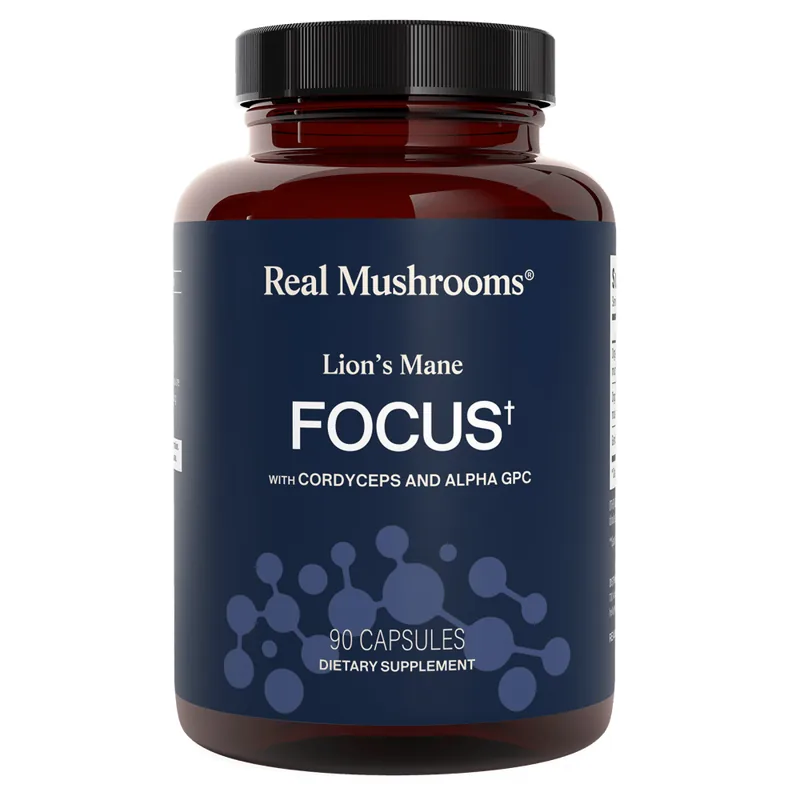
A dark amber bottle with a black cap and a navy label, about the height of a coffee mug.
The front says Lion's Mane, then FOCUS in large capitals with the little dagger every supplement in America carries, then "with cordyceps and Alpha GPC."
The back is the panel, and I'll read it to you in the seller's order, per two capsules:
Organic lion's mane, Hericium erinaceus, mushroom extract, 500 milligrams.
Organic cordyceps, Cordyceps militaris, mushroom extract, 100 milligrams.
GeniusPure Alpha GPC, 200 milligrams.
Other ingredients: hypromellose, which is the vegetable capsule, silicon dioxide, stearic acid, and microcrystalline cellulose as a flow agent.
The directions are five words: adults take two capsules per day.
The listing adds "with or without food," and says the formula is non-stimulating by design and "not a quick" answer "or productivity spike," which is the most honest sentence I've read on a supplement listing in a while.
There's no caffeine here, and the seller says so on purpose.
If you feel anything on day one, it's the coffee.

Line two · Lion's maneFive Hundred Milligrams, and the Trial That Used Three Point Two Grams a Day
The line the bottle is named for, and the line with the best trial in people my age.

Lion's mane is an edible mushroom with long white spines that grows on old beech and oak trees, and in Japan it has a name, yamabushitake, and a place on the plate.
The trial worth reading is small and has been read many times.
Thirty-one Japanese adults over 50 took a daily preparation of the dried fruiting body, 3.2 grams a day, or a placebo, for twelve weeks.
The lion's mane group scored higher on a standard mental-status test than the placebo group, and the difference faded in the weeks after they stopped. [1]
Three point two grams a day, in tablets, three times a day, for twelve weeks.
Two capsules hold 500 milligrams of extract, from the fruiting body, which is the right part of the mushroom.
That's a sixth of the trial's daily amount.
Not a rounding error; a sixth.
There's a second study, in younger people, that's honest to mention.
Forty-one healthy adults aged 18 to 45 took a single 1.8-gram dose or a placebo, and the lion's mane group was faster on an attention task an hour later; after 28 days at that dose there was a trend on one questionnaire and nothing clear on the other tests. [2]
One point eight grams, once.
Two capsules are a little over a quarter of that.
Lion's mane at 500 milligrams is a real amount of a real mushroom, from the right part of it, and it sits at a sixth of the dose that produced the only twelve-week result in people over 50.
The seller sells the same extract without the other two lines, at a thousand milligrams per two capsules.
I mention it because it's the arithmetic that matters: if the mushroom is what you're after, this bottle gives you half of what the plain one does, and spends the rest of the capsule on the next two lines.

Line three · Alpha GPCTwo Hundred Milligrams of a Choline Compound, and the Eighty Milligrams of Choline Inside It
The line with the longest name, the shortest evidence, and one piece of arithmetic worth doing.
Alpha GPC is choline joined to a small phosphate group.
The body makes a little of it when it breaks down the choline-carrying fats in cell membranes, and it's found in milk and in organ meats.
In a supplement it's a concentrated way to deliver choline, which is the nutrient the brain uses to build one of its chemical messengers and the membranes of its cells.
Now the arithmetic.
Alpha GPC is about 40 percent choline by weight.
So 200 milligrams of Alpha GPC delivers roughly 80 milligrams of choline.
The Daily Value printed on American labels for choline is 550 milligrams. [3]
Eighty milligrams is about a seventh of a day's choline: what you'd get from an egg and a half, or a glass of milk and a chicken thigh.

What does choline do for memory in people my age?
The best answer I could find isn't a trial of a capsule.
It's a cohort.
In the Framingham Offspring study, 1,391 adults aged 36 to 83 had their diets recorded, and the ones who ate more choline scored better on verbal and visual memory tests. [4]
That's people eating eggs, milk, meat and beans over years, not people taking 80 milligrams from a capsule.
And I could find no trial of Alpha GPC itself on memory or attention in healthy older adults, so I won't pretend there is one.
Two hundred milligrams of Alpha GPC is 80 milligrams of choline, a seventh of a day's need, with no trial of its own in healthy men over 50. It's a nutrient in a capsule, delivered honestly and in a small amount.
If choline is what you want, breakfast does it for less. If a measured 80 milligrams alongside the mushroom is what you want, that's what this line is.
Line four · CordycepsOne Hundred Milligrams in a "Complementary Role," and No Memory Trial
The smallest line, and the one the seller describes most carefully.
Cordyceps militaris is an orange club-shaped fungus grown commercially on grain or in liquid culture, sold as a stand-in for the wild caterpillar fungus of Tibet, which is far too rare and expensive for a capsule.
The seller says it's included "in a complementary role to support the overall formula, without introducing stimulation," which is a careful way of saying it isn't the reason you'd buy the bottle.
I registered no randomized trial of cordyceps on memory or attention in healthy adults.
The human studies I could find were about exercise performance, and they were small and mixed.
At 100 milligrams, it's less than half of what the seller puts in its own cordyceps capsules, and a tenth of what a serious exercise study would use.
Cordyceps at 100 milligrams: a real mushroom, an honest description, and no memory trial. It's the garnish on the panel, and the seller more or less says so.

Count the lines that meet their trial at their own dose, in people your age, and you get none.
The mushroom is at a sixth.
The choline is a seventh of a day's need.
The cordyceps has no trial to meet.
Line five · The reviewsTen Reviews, Nine of Them Five Stars, and the One That Explains the Ten Dollars
The seller's product page shows ten reviews, each with the store's own buyer mark, nine of them at five stars.
The seller's page also prints a note saying its average rating and review count are aggregated from Amazon and its own store, so the big number you may see there isn't the ten.
I read all ten and kept five, including the one at three stars, which is the most useful review on the page.
Michael B. writes that he's leaving his review because the seller said it would give him a ten-dollar credit for one, and that he can't tell what the capsules are doing for him.
That's a customer telling you two true things at once: that the seller pays a little for reviews, and that after a bottle he couldn't say.
I'd have kept his review if it were the only one.
I threw out one that spoke of a serious health matter, one that talked about the night, and three that either didn't carry the buyer's mark or didn't say anything.
The rest are real customers, quoted word for word from the seller's product page; the small photos beside them are illustrations, not the reviewers.

I've been taking the focus mix for a few weeks and I love it! I can feel the difference in my ability to sustain focus within 30 minutes of taking it. Its become an irreplaceable staple in my daily routine. Highly recommend!

I love lions Maine Focus. I take it every morning and I'm ready for the day and stay lazer focused on what I am doing.

A fantastic product! The combination of high grade, functional mushrooms with Alpha-GPC taken a couple of hours before exercise adds a boost which I notice.

I'm only leaving this review because Real Mushrooms said they would give me a $10 credit to leave a review. I really don't know and I can't tell what is actually happening for me by taking these, but I guess psychologically I feel good about taking them. I trust the company.
Read those the way I did.
Thomas feels something within thirty minutes.
Nothing on this panel has a thirty-minute trial in people his age; the lion's mane study took twelve weeks, and the choline is a seventh of breakfast.
I believe he feels something, and I'd ask what else he had that morning.
Amanda takes it every morning and feels ready for the day.
That's a routine, and routines are real.
P.S. takes it before exercise and notices a boost.
Cordyceps is an exercise ingredient with small mixed trials; that's the most plausible thing anyone on the page describes.
Michael can't tell, and says so, and tells you about the ten dollars.
Nobody I kept describes their memory coming back.
Two describe mornings that go well, one describes a workout, and one describes not being able to tell.
That's what three honest lines at these doses look like from the customer's side of the counter.
Line six · The two promisesA Hundred Days on One Page, Thirty and Unopened on the Other
This is the section I'd read twice if I were you, because it's the one where the seller's pages disagree.

The product page and a page of its own, called the 100-Day Satisfaction Promise, say this: on every product the seller makes, if it isn't the right fit, the seller will help you find one that is, or make it right with a replacement or a full refund.
One opened product per customer.
Meant for reasonable evaluation, not for eating through several bottles.
Only for purchases made on the seller's own site.
Contact by email, phone or text.
The seller's return policy, a different page, says this: unopened, unused products within 30 days of shipping can be returned with a prepaid label; from 31 to 60 days you pay the shipping; after 60 days, no returns; opened products are not accepted, "no exceptions."
The same page also mentions a 30-day satisfaction promise, with a refund of the product price or an exchange, for purchases on the seller's site.
So which is it?
I take the seller at its most recent and most specific word, which is the hundred-day page: one opened bottle, per customer, evaluated in good faith, refund or replacement.
But I'd write to the seller before I bought, ask which page governs, and keep the answer.
A promise that lives on one page and is contradicted on another is a promise you want in writing.
A hundred days for one opened bottle on the promise page; thirty days and unopened on the return page. Ask first, keep the email, and buy one bottle.
Line seven · The bowl and the cupThe Cereal, the Three Drinks, the Three Foods and the Word Test From Our Own Advertisements
Our advertisements have been saying, in one version or another, that a boxed cereal, three foods and three drinks have something to do with memory, and that there are three words or phrases a man ought to be able to say.
You're owed the honest version, on one line, so here it is.
Start with the bowl.
A frosted, honey-coated or chocolate cereal is mostly refined starch and added sugar, and a serving can carry more sugar than a cookie.
No cereal "ages the brain faster than time."
Nobody has measured any such thing, and that phrase was written to be clicked.
What the studies do say is duller, and worth more.
In the Framingham Heart Study, adults who drank more sugary beverages scored lower on tests of memory, and daily fruit juice went the same way. [5]
In a Brazilian study of 10,775 adults followed for eight years, the ones who ate the most ultra-processed food, and the sweet cereal shelf is part of that, lost ground on tests of thinking about a quarter faster than the ones who ate the least. [6]
Both are associations across a population, not a sentence on your bowl.
And a quarter faster than slow is still slow.
The same Framingham families, in a different analysis, are the ones who scored better on memory tests when their diets carried more choline, [4] which is a better argument for eggs at breakfast than for the cereal, and a better argument for eggs than for a capsule.
The three drinks.
The "evening drink" in our advertisement is alcohol, and it's the one with the strongest case behind it: in 550 British civil servants followed for thirty years, the more a person drank, the faster their scores fell on a word-fluency test, and light drinkers had no edge over those who didn't drink at all. [7]
The second is sugar in a glass: soda, sweetened tea, the tall flavored coffee from the counter, which is a soft drink with coffee in it.
The Framingham finding above is about sugary drinks, and those are sugary drinks. [5]
The third, in one of our headlines, was coffee.
That was our worst headline.
Plain black coffee and plain tea aren't the drinks any of those studies were about.
Keep your coffee.
These capsules have no caffeine, and taking them doesn't change how much you're drinking.
The three foods.
Processed meat, fried food, and the white-flour shelf: pastries, packaged cakes, white bread.
Our advertisement says "just stop eating these three."
The research says something slower.
In 960 older adults followed for nearly five years, the ones whose meals looked most like the MIND pattern, vegetables, berries, nuts, whole grains, beans, fish and olive oil, held their thinking scores better, and the gap between the top and bottom thirds worked out to about seven and a half years of age. [8]
That's a pattern over years, not a list of three, and it can't be sold in a headline.
Which is exactly why our headline doesn't say it.
Less sugar in the bowl and the glass.
Less alcohol in the evening.
Keep the coffee.
Eat more like the Mediterranean shelf and less like the vending machine.
Every one of those costs nothing, and none of them is in the capsule.
The three words, or the three phrases.
There's no such list.
What our advertisement borrowed from is the short, scored mental-status test clinicians have given at the bedside since the 1970s: the date and the place, a few words to hold in mind and give back a minute later, a sum, naming, repeating one sentence, copying a drawing.
It's given in person and read against your age and your schooling by someone trained to do it, and a low score is a reason for a proper look, not a verdict.
Stumbling on a word when you're tired or being timed means nothing on its own.
Nothing begins at a word.
If the worry behind the click is real, that's fifteen minutes with your own clinician, and it costs you nothing from me.
And the advertisement about the things some men take every day.
That one sits closest to real research, and it's the one an advertisement has no business acting on.
Some kinds of daily medicine, including a few sold over the counter for allergies and for the night, are on the lists pharmacists check for people over 65.
Don't stop or change any of it because of an advertisement, ours included. Put everything you take in one bag, this bottle included, take it to the pharmacist, and ask one question: is anything here a poor choice at my age?
The label itself tells you to ask if you take anything daily.
The guide at the foot of this page has that section written out, with the studies.
So if you clicked on the cereal, here's where the cereal went: onto the counter next to a bottle that has nothing to do with it, where the real answer was always a plainer bowl and a couple of eggs.
Line eight · What it isn'tSix Things Two Capsules Won't Do
- It won't wake you up. There's no caffeine in it, and the seller says so on purpose.
- It won't give you the lion's mane of the trial. Five hundred milligrams is a sixth of the 3.2 grams a day that produced the twelve-week result, and half of what the seller's plain lion's mane capsules hold.
- It won't give you a day's choline. Eighty milligrams is a seventh of it; breakfast does the rest.
- It won't act on any condition a clinician has named. It's a dietary supplement, and its own label carries the sentence that says so.
- It won't tell you within thirty minutes whether it's working, whatever one reviewer felt. The only twelve-week result on this panel took twelve weeks.
- It won't come with one return policy. It comes with two, and you should ask which one applies before you buy.
If that list annoys you, I'd rather you were annoyed now than when the bottle arrives from Nevada.
Line nine · The routineIf You Do Buy It: One Bottle, Two Capsules at Breakfast, Forty-Five Days, One Notebook
If you're going to spend the money, spend it as a test with a date on it, and test the line that can actually work.
- Buy one bottle. Ninety capsules is forty-five days, and the hundred-day promise, if it governs, covers one opened bottle per customer; a second bottle is a bet.
- Email the seller first and ask which return page applies to an opened bottle. Keep the reply.
- Two capsules with breakfast, the same breakfast every day. Eggs if you like them: that's where the rest of the choline comes from.
- Keep the coffee exactly as it was. There's nothing stimulating in the capsule, so nothing about your morning should change.
- Write one line a day in a notebook. Not "sharper" or "foggier." What you were doing at ten, and how it went.
- On day forty-five, read the forty-five lines. If they read better than the month before, you've found a habit. If they don't, you've found out for the price of one bottle, and the promise page says you can ask for the money back.
Look at that list the way I do.
Four of the six things cost nothing.
The bottle is the one you'll pay for, and the notebook and the same breakfast at the same hour are the ones that will do the work.

Line ten · Who it's forWho It Suits, and Who It Doesn't
This is worth a look if:
- You want a mushroom capsule with three lines you can read and no caffeine, and you've now read what each of the three lines weighs against its trial.
- You want a measured 80 milligrams of choline alongside 500 milligrams of lion's mane from the fruiting body, and you know breakfast supplies the rest.
- You want a company with a street address, a toll-free number and an email, and a warehouse in the United States. You have all four now.
- You can hold two ideas at once: three real lines, none at the dose of the trial that made it famous.
- You'll email the seller about the promise first, and run the bottle as a forty-five-day test with a notebook.
Give it a miss if:
- You want lion's mane at its trial dose. Two capsules are a sixth of it; the seller's plain capsules are a third of it for less money.
- You want something that acts on a condition a clinician has named. This is a dietary supplement.
- You want a return policy that says one thing. This seller's pages say two, and the return page is the stricter one.
- You take anything daily and haven't asked a pharmacist. The label tells you to ask; do that first.
- You want customer reviews that weren't nudged by a credit. One reviewer says the seller offered ten dollars; read the others with that in mind.
Line eleven · Where it's soldFrom Calgary, Shipped From Nevada, With Shipping at No Charge Above a Line
The bottle is sold by Real Mushrooms on its own website, and that's the only place this page links to.

The company is easy to find.
Real Mushrooms Inc., with its office on Fifth Avenue Southwest in Calgary printed on the label, a second Calgary address on its return page, a toll-free number that takes calls and texts, and an email.
American orders ship from a warehouse in Sparks, Nevada, which is also where returns go.
The label says the extract is verified for its active compounds and tested by an independent lab, and the seller's plain lion's mane label prints its beta-glucan figure, which this one doesn't.
The current price is shown on its page, not here.
The day I read it, a bottle of ninety cost about what a decent pair of work gloves costs, and it worked out to under a dollar a day.
Buy one bottle.
Forty-five days is a test.
A second bottle of something you haven't finished is a bet, and the promise covers one.
Now the two things that matter more than the price.
First, shipping.
Real Mushrooms ships within the United States from Nevada; shipping costs nothing above the seller's order line, and a single bottle, the day I read it, was below that line, so expect a small shipping charge.
Second, the return policy.
Read this twice, because there are two of them.
The promise page: a hundred days, one opened product per customer, replacement or refund, by email, phone or text, for purchases on the seller's site only.
The return page: unopened products only, prepaid label within 30 days of shipping, your postage from 31 to 60 days, nothing after 60, and opened products not accepted.
Both pages are the seller's own words.
Ask which one applies before you pay, and keep the answer.
I'd rather say so than call it a refund with no strings.
Everything in two capsules
| Ingredient | Amount per serving |
|---|---|
| Organic lion's mane (Hericium erinaceus) mushroom extract, fruiting body | 500 mg |
| Organic cordyceps (Cordyceps militaris) mushroom extract, fruiting body | 100 mg |
| GeniusPure® Alpha GPC (L-alpha glycerylphosphorylcholine) | 200 mg |
| Other ingredients: hypromellose (vegetable capsule), silicon dioxide, stearic acid, microcrystalline cellulose | — |
Full details on each ingredient are in the guide linked at the bottom of this page.
The ingredient and advertising guide linked at the foot of this page goes through every one of the three lines.
What each ingredient is.
What the research does and doesn't show, at what dose.
What to be careful about.
And which of our own headlines it does and doesn't support.
Print it and take it to the pharmacist if you take anything daily.
It's written for that.
See the current price on the seller's site
Two capsules a day of organic lion's mane extract with cordyceps and a choline compound, from a Canadian mushroom company that ships from Nevada.
CHECK AVAILABILITYSold by Real Mushrooms Inc., Calgary, and shipped within the United States from Sparks, Nevada · Shipping at no charge above the seller's order line; a single bottle is below it · A 100-day satisfaction promise on one opened product per customer on the seller's promise page, and a stricter unopened-only return policy on its return page: ask the seller which applies before you buy
QuestionsWhat Readers Ask Me Before Their First Bottle
Questions readers ask
Is this medicine?
No. It's a dietary supplement, three ingredients in a vegetable capsule, made in the United States for a company in Calgary.
The label carries the standard sentence every American supplement carries, the one that says the FDA hasn't evaluated its claims, and the little dagger after FOCUS points to it.
Does it have caffeine?
No. The seller says the formula is non-stimulating on purpose.
Whatever wakes you up is your coffee.
Which of the three lines actually does something?
None meets its trial at its own dose. Lion's mane is at a sixth of the 3.2 grams a day of the twelve-week trial in adults over 50.
Alpha GPC delivers about 80 milligrams of choline, a seventh of a day's need, with no trial of its own in healthy older adults. Cordyceps has no memory trial and the seller calls it complementary.
It's all on this page, line by line.
What is Alpha GPC, in plain words?
Choline attached to a small phosphate group, so it's a concentrated way to deliver choline, the nutrient the brain uses for one of its messengers and its cell membranes. About 40 percent of it by weight is choline, so 200 milligrams gives you about 80.
An egg and a half gives you about the same.
Will it help my memory?
I can't tell you that, and you should be wary of any page that does. No line on the panel meets a memory trial in people your age at its own dose.
What the customers I kept describe is mornings that go well, one workout, and one man who can't tell.
Can I take it alongside what I already take?
Ask your clinician or pharmacist and take the ingredient guide with you. The label itself says to check with a clinician if you take anything daily.
Two minutes at the pharmacy counter answers it.
Are the reviews real?
They're public on the seller's page and carry its buyer mark. One reviewer says the seller offered a ten-dollar credit for a review, so I've marked that one and I'd read the rest with it in mind.
I quote them word for word.
Does it ship to me?
Within the United States, from Nevada. At no charge above the seller's order line; a single bottle is below it, so expect a small charge.
What if it arrives and I don't like it?
The seller's promise page says a hundred days and one opened bottle per customer, by email, phone or text. Its return page says unopened bottles only, within 30 days for a prepaid label.
Write to the seller before you buy, ask which applies, and keep the reply.
Your advertisement was about a cereal, or three foods, or three drinks. Where is that on this page?
On line seven, in full, with the studies. The short version: less sugar in the bowl and the glass, less alcohol in the evening, keep your plain coffee, and eat more like the Mediterranean shelf.
None of it is in the capsule, and the ingredient and advertising guide at the foot goes through every headline we run and says which ones overstate.
Your advertisement said something about three phrases, or spelling three words. Is there a test I can take?
Not on a screen. The words and phrases come from the short mental-status test clinicians give in person, and it's read against your age and schooling by someone trained to do it.
Nothing begins at a word. If the worry behind the click is real, ask your clinician for the proper test.
It's fifteen minutes.
The short versionEverything Above, in Sixty Seconds
- A bottle of ninety vegetable capsules from Real Mushrooms of Calgary, shipped from Nevada: organic lion's mane extract 500 milligrams, organic cordyceps extract 100 milligrams and Alpha GPC 200 milligrams per two capsules, no caffeine, forty-five days to the bottle.
- Lion's mane: a sixth of the 3.2 grams a day of the twelve-week trial in adults over 50. [1] Alpha GPC: about 80 milligrams of choline, a seventh of the 550-milligram Daily Value, [3] with a cohort behind dietary choline [4] and no trial of its own. Cordyceps: no memory trial.
- Ten reviews with the seller's verified mark; the four I kept say "within 30 minutes," "every morning," "before exercise," and "I can't tell," and one of them says the seller offered ten dollars for a review.
- Ships from Nevada; at no charge above the seller's line; a hundred-day promise on one opened bottle on one page, and an unopened-only return rule on another: ask first.
- The cereal, three drinks, three foods and the word test from our own advertisements, on line seven: less sugar, less alcohol, keep the coffee, more like the Mediterranean shelf, eggs for the choline, and no test on a screen. None of it is in the capsule.
- The honest use: two capsules with the same breakfast for forty-five days, a notebook, and an email to the seller before you pay.

The last lineWhat Two Capsules Are Actually Worth
Here's the whole thing in one breath.
Three real lines in a well-made capsule, from a company that prints every one of them, tests its extracts, and tells you where the mushroom comes from.
None at the dose of the trial that made it famous.
The mushroom at a sixth, the choline at a seventh of a day, the cordyceps without a trial.
No caffeine, no blend, no number left off.
And two return pages, one generous and one strict, waiting for you to ask which is which.
If you're a man who wants a short, honest mushroom capsule with a little choline in it, tested over forty-five days with a notebook, that's worth one bottle.
Not because of the word on the front.
Because you'll know exactly what's in the two capsules, and exactly what isn't.
Buy one bottle, email the seller about the promise first, take two capsules with the same breakfast, and write one line a day for forty-five days. The notebook is a better judge than I am.
Check the current price and availability
Two capsules a day of organic lion's mane extract with cordyceps and a choline compound, from a Canadian mushroom company that ships from Nevada.
CHECK AVAILABILITYSold by Real Mushrooms Inc., Calgary, and shipped within the United States from Sparks, Nevada · Shipping at no charge above the seller's order line; a single bottle is below it · A 100-day satisfaction promise on one opened product per customer on the seller's promise page, and a stricter unopened-only return policy on its return page: ask the seller which applies before you buy
P.S. If you take one thing from this page, take the two numbers.
Five hundred milligrams of lion's mane, a sixth of the trial.
Eighty milligrams of choline, a seventh of a day.
Everything else about this bottle sits between those two.
P.P.S. If the afternoon fog has been with you for a year, and it's there before the coffee too, talk to your own clinician before you buy anything.
Two capsules at breakfast are a small habit.
They were never going to answer a question a clinician answers in fifteen minutes and a blood test.
P.P.P.S. And if you do order it, keep the notebook, and keep the seller's email about the promise.
When the bottle is empty, you'll have forty-five lines about your own mornings and one answer in writing, and both are worth more than the bottle, whichever way the lines turn out.